Masters in Nottingham in 2026
Table of Contents
- Why Study a Masters in Nottingham?
- Top Universities for Masters in Nottingham
- Popular Masters Courses in Nottingham
- Eligibility and Admission Requirements for Masters in Nottingham
- How to Apply for Masters in Nottingham
- Cost of Studying Masters in Nottingham
- Scholarships for Masters in Nottingham
- Jobs and Salary After Masters in Nottingham
- Student Visa for Masters in Nottingham
- Final Thoughts from the Author
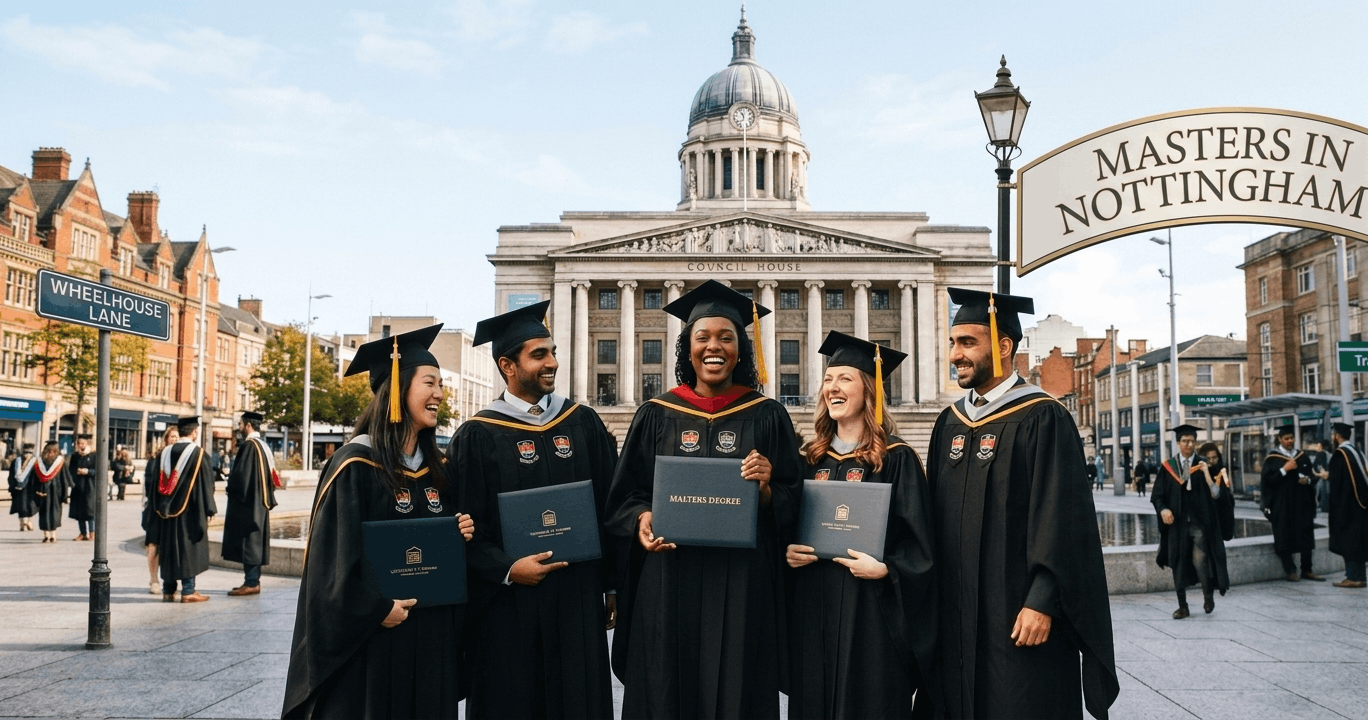
Pursuing a Masters in Nottingham gives you the opportunity to study in one of the UK's most student-friendly and affordable cities. Home to the University of Nottingham and Nottingham Trent University, the city offers a wide range of postgraduate programmes across business, engineering, computer science, healthcare, arts, and social sciences. With globally recognised universities, strong industry links, and excellent graduate employment prospects, Nottingham attracts students from around the world every year.
In this guide, you'll explore everything you need to know about Masters in Nottingham, including top universities, popular courses, tuition fees, eligibility, scholarships, living costs, career opportunities, and visa requirements.
Key Highlights: Masters in Nottingham
Particular | Details |
Top Universities | University of Nottingham, Nottingham Trent University |
Popular Courses | MSc Data Science, MSc Business Analytics, MSc Finance, MSc Computer Science, MSc Mechanical Engineering, MPH, MSc Psychology |
Course Duration | 1–2 years |
Tuition Fees | Approximately £22,000–£39,600 (₹28.11 lakh–₹50.61 lakh) per year (varies by course and university) |
Average Monthly Living Cost | £850–£1,250 per month (₹1.09 lakh–₹1.60 lakh) excluding tuition. |
Post-Study Work Visa | UK Graduate Route (2 years) |
Top Recruiters | Rolls-Royce, Experian, Boots, Deloitte, NHS, IBM, PwC |
Why Study a Masters in Nottingham?
Picking a city for your postgraduate degree isn't just about chasing a ranking number. Nottingham has quietly built a reputation for getting the balance right: solid academics, a cost of living that doesn't wreck your budget, and genuine connections to employers who actually hire from these programmes.
A few reasons students keep landing here:
Two well-regarded universities, both known for research output and decent graduate employment rates
Hundreds of postgraduate courses spanning business, engineering, healthcare, computing, law, and the arts, so switching fields mid-career isn't off the table
Rent and daily expenses that sit noticeably below London, without giving up much in terms of transport links or campus facilities
Real industry exposure baked into many courses, including internships, employer talks, and placement schemes rather than just lecture halls
A genuinely international cohort, with students arriving from over 150 countries
The option to stay back and work through the UK's Graduate Route, currently up to two years post-degree for most graduates
Top Universities for Masters in Nottingham
Nottingham runs on two universities, and each one pulls in a different kind of student. One leans into research depth. The other leans into getting you job-ready. Both have the infrastructure and support systems that international students actually need. The question is which teaching style fits you.
Best Universities for Masters in Nottingham:
University | QS World University Rankings 2027 | Popular Masters Courses |
University of Nottingham | #97 | MSc Data Science, MSc Business Analytics, MSc Finance, MSc Computer Science, MSc Mechanical Engineering, Master of Public Health |
Nottingham Trent University | =639 | MSc Management, MSc Artificial Intelligence, MSc Finance, MSc Cyber Security, MSc Construction Management |
Which University Should You Choose?
Honestly, it comes down to what you want out of the degree. If you're eyeing a PhD later, or you want a name that carries weight globally, the University of Nottingham's research standing makes it the safer bet.
If you're after a faster route into a job, with placements and employer-designed modules built in, Nottingham Trent tends to deliver on that front. Either way, don't just go by reputation. Dig into the actual course modules, what the fees look like, and where recent graduates ended up before you commit.
Popular Masters Courses in Nottingham
Between the two universities, there's a genuinely wide spread of subjects on offer, which is part of why Nottingham attracts such a mixed crowd of students. Whether you're coming from a business background or a technical one, the courses are generally built to pair theory with something you can actually put on a CV.
1. Business and Management Courses
Business degrees are consistently among the first things students look at here, and it's easy to see why. There are clear pathways into finance, consulting, and marketing roles, with plenty of overlap between the two universities' offerings.
MSc Business Analytics
MSc Management
MSc Finance
MSc Marketing
MSc International Business
MSc Accounting and Finance
2. Engineering and Technology Courses
This is arguably where Nottingham's academic reputation is strongest. The engineering and computing programmes lean heavily on lab work and industry projects, not just theory on a whiteboard.
MSc Mechanical Engineering
MSc Civil Engineering
MSc Electrical and Electronic Engineering
MSc Advanced Manufacturing Engineering
MSc Artificial Intelligence
MSc Cyber Security
MSc Data Science
MSc Computer Science
3. Health and Life Sciences Courses
For anyone heading into healthcare, research, or public health work, there's a solid range of options, some clinical and some more research-driven.
Master of Public Health (MPH)
MSc Biotechnology
MSc Biomedical Sciences
MSc Clinical Nutrition
MSc Nursing
MSc Psychology
4. Arts, Social Sciences, and Law
And for students drawn to law, policy, or the humanities, Nottingham still has plenty to offer: programmes that push analytical thinking and research skills just as hard as the science courses do.
LLM (Master of Laws)
MSc Economics
MA International Relations
MA Education
MA Media and Communications
MA English Studies
Eligibility and Admission Requirements for Masters in Nottingham
Admission requirements for Masters in Nottingham vary by university and course, but the overall process is straightforward. Universities assess your academic background, English language proficiency, and supporting documents to determine whether you're prepared for postgraduate study. Some professional programmes may also ask for relevant work experience.
Academic Requirements
Most universities require applicants to hold a bachelor's degree from a recognised institution in a relevant subject. The minimum academic requirement may differ by programme, and some courses also consider relevant professional experience alongside academic qualifications.
Typical academic requirements include:
A recognised bachelor's degree in a relevant discipline
Minimum academic score as specified by the university and course
Relevant work experience (required for selected professional programmes)
Subject-specific prerequisites for certain technical or specialised courses
English Language Requirements
International students whose first language is not English must demonstrate English language proficiency. Universities accept tests such as IELTS, TOEFL iBT, and PTE Academic, although the required scores vary by programme. Some Indian applicants may also qualify for exemptions based on previous qualifications.
Accepted English language tests include:
IELTS Academic
TOEFL iBT
PTE Academic
Other recognised English language qualifications accepted by the university
Documents Required
Preparing your documents before applying can help speed up the admission process. While requirements differ between universities and courses, most postgraduate applications ask for the following documents.
You'll typically need:
Completed online application form
Bachelor's degree certificate and academic transcripts
English language test scores (if applicable)
Statement of Purpose (SOP)
Updated CV or résumé
Two Letters of Recommendation (LORs)
Copy of your passport
Portfolio (for design, architecture, or creative programmes, where required)
How to Apply for Masters in Nottingham
Applying for Masters in Nottingham is a straightforward process, but it's important to plan. Most universities accept online applications throughout the year, although some courses have specific deadlines. Applying early also gives you enough time to arrange your visa, accommodation, and finances before your programme begins.
Step-by-Step Application Process:
Following a structured application process can improve your chances of receiving an admission offer and avoid delays during document verification.
Step 1: Choose Your Course and University
Compare universities based on course content, tuition fees, rankings, and career outcomes.
Check the entry requirements for your chosen programme.
Step 2: Prepare Your Documents
Gather your academic transcripts, degree certificate, English language test scores, SOP, LORs, CV, and passport.
Step 3: Submit Your Online Application
Complete the application through the university's official admissions portal.
Upload all required documents and pay the application fee (if applicable).
Step 4: Receive Your Admission Decision
Universities review your application and may issue either a conditional or unconditional offer.
Step 5: Accept the Offer
Accept your preferred university's offer and complete any remaining admission requirements, such as paying the tuition deposit.
Step 6: Apply for a UK Student Visa
Once you receive your Confirmation of Acceptance for Studies (CAS), apply for your UK Student visa and prepare for your move to Nottingham.
When Should You Apply?
Most universities offer multiple intakes, with September being the primary intake for postgraduate programmes. Some courses also have January or May intakes, depending on the university.
For the best chance of securing admission, scholarships, and accommodation, it's advisable to start your application 6–12 months before your intended intake. This also provides enough time to arrange funding and complete the student visa process.
Cost of Studying Masters in Nottingham
The total cost of Masters in Nottingham includes tuition fees and everyday living expenses. Your overall budget will depend on the university, course, accommodation type, and lifestyle. Planning these costs in advance can help you manage your finances and avoid unexpected expenses during your studies.
Tuition Fees for Masters in Nottingham
Tuition fees vary by university and programme. Courses in business, engineering, and healthcare generally cost more than those in the humanities or social sciences. Always check the latest fee for your chosen course on the university's official website before applying.
University | Annual Tuition Fees (International Students) |
University of Nottingham | £22,000–£39,600 (≈ ₹25.5 lakh–₹45.9 lakh) |
Nottingham Trent University | £18,500–£28,500 (≈ ₹21.4 lakh–₹33.0 lakh) |
Cost of Living in Nottingham
Compared with many other major UK cities, Nottingham offers a relatively affordable student lifestyle. Your monthly expenses will vary depending on where you live and your spending habits, but accommodation is usually the largest part of the budget.
Expense | Average Monthly Cost |
Accommodation | £550–£850 (≈ ₹63,700–₹98,500) |
Food & Groceries | £180–£250 (≈ ₹20,900–₹29,000) |
Transportation | £50–£70 (≈ ₹5,800–₹8,100) |
Utilities & Internet | £80–£120 (≈ ₹9,300–₹13,900) |
Personal Expenses | £100–£180 (≈ ₹11,600–₹20,900) |
Estimated Total | £960–£1,470 (≈ ₹1.11 lakh–₹1.70 lakh) |
Source: Numbeo
Scholarships for Masters in Nottingham
Studying abroad can be a significant financial commitment, but many universities in Nottingham offer scholarships to help international students reduce their tuition costs. Most scholarships are awarded based on academic merit, leadership potential, or the course you've applied for. It's worth checking the eligibility criteria and application deadlines before submitting your application.
University Scholarships
Both the University of Nottingham and Nottingham Trent University offer scholarships for international postgraduate students. Some awards are applied automatically, while others require a separate application after you've received an admission offer.
University | Scholarship | Benefit |
University of Nottingham | International Postgraduate Scholarship | Tuition fee scholarship for eligible international Masters students. |
University of Nottingham | Developing Solutions Masters Scholarship | Covers 50% or 100% of tuition fees for eligible students from selected countries. |
University of Nottingham | GREAT Scholarship | Tuition fee support for eligible students from selected countries in partnership with the British Council. |
Nottingham Trent University | International Scholarship | Merit-based scholarships for new international students enrolling in eligible postgraduate programmes. |
Nottingham Trent University | MBA Excellence Scholarship | Tuition fee award for outstanding MBA applicants demonstrating leadership potential. |
Jobs and Salary After Masters in Nottingham
A Masters degree from Nottingham can open doors to opportunities across the UK and internationally. The city's strong links with industries such as healthcare, engineering, finance, technology, and manufacturing help graduates connect with employers through placements, networking events, and graduate recruitment programmes.
Average Salary After Masters in Nottingham
Graduate salaries vary depending on your industry, job role, qualifications, and previous work experience. While some graduates begin with entry-level positions, others secure specialist or management roles with higher starting salaries.
Job Role | Average Annual Salary |
Data Analyst | £35,000–£45,000 (≈ ₹40.5 lakh–₹52.1 lakh) |
Business Analyst | £38,000–£50,000 (≈ ₹44.0 lakh–₹57.9 lakh) |
Software Engineer | £40,000–£55,000 (≈ ₹46.3 lakh–₹63.7 lakh) |
Financial Analyst | £38,000–£52,000 (≈ ₹44.0 lakh–₹60.2 lakh) |
Project Manager | £45,000–£60,000 (≈ ₹52.1 lakh–₹69.5 lakh) |
Source: Glassdoor UK
Top Recruiters in Nottingham
Nottingham is home to several multinational companies and public sector organisations that regularly hire graduates. Universities also organise career fairs and employer networking events to help students explore job opportunities.
Some of the top recruiters include:
Rolls-Royce
Boots UK
Experian
Deloitte
PwC
KPMG
IBM
NHS
Capital One UK
Siemens
Post-Study Work Opportunities
International students who complete eligible postgraduate programmes can apply for the UK Graduate Route. This visa allows graduates to stay and work in the UK for up to two years after completing their degree without requiring immediate employer sponsorship. Many students use this period to gain professional experience and transition into long-term employment.
Student Visa for Masters in Nottingham
International students planning to pursue Masters in Nottingham must apply for a UK Student visa before travelling. Once you receive your Confirmation of Acceptance for Studies (CAS) from your university, you can begin the visa application process. Applying early and preparing the required documents can help avoid delays before your course starts.
Eligibility and Documents Required
To apply for a UK Student visa, you'll need to meet the eligibility requirements and submit supporting documents as part of your application.
You'll typically need:
A valid passport
Confirmation of Acceptance for Studies (CAS)
Proof of sufficient funds to cover tuition fees and living expenses
English language proficiency evidence (if required)
Tuberculosis (TB) test certificate (for applicants from eligible countries)
Academic documents requested by your university
Completed online visa application
Student Visa Fees
The cost of a UK Student visa includes the visa application fee and the Immigration Health Surcharge (IHS), which gives students access to the UK's National Health Service (NHS).
Fee | Amount |
UK Student Visa Application Fee | £524 (≈ ₹60,700) |
Immigration Health Surcharge (IHS) | £776 per year (≈ ₹89,900 per year) |
Student Visa Processing Time
Most UK Student visa applications submitted outside the UK are processed within three weeks after attending the biometric appointment. However, processing times may vary depending on your country of application and the volume of applications. Applying well before your course start date provides enough time to respond to any additional document requests if needed.
Final Thoughts from the Author
Choosing Masters in Nottingham is about more than selecting a university with a good ranking. The right programme should match your academic interests, career plans, budget, and the type of learning experience you're looking for. Taking the time to compare course content, tuition fees, scholarships, and graduate outcomes can help you make a more informed decision.
Nottingham offers a balance of quality education, research opportunities, and a student-friendly environment without the higher living costs associated with some other UK cities. If you start your application early and plan your finances carefully, you'll have more time to focus on finding the university and course that best support your long-term goals.
Connect with our experts for a free 1:1 counseling session to explore course options, career pathways, and more.